
In recent days, international economic discussions have increasingly focused on a hypothetical scenario involving rising economic tensions between the United States and Spain following several controversial political statements by Donald Trump.
Although no official break in economic relations has taken place—and most analysts consider such a scenario unlikely—the debate itself is already raising questions among international investors. This is particularly relevant for those considering property in Mallorca as a long-term investment.
Could geopolitical tensions and potential instability in global energy markets affect one of Europe’s most resilient property destinations — the Mallorca real estate market? For investors exploring Mallorca property investment, understanding these geopolitical developments has become increasingly important.
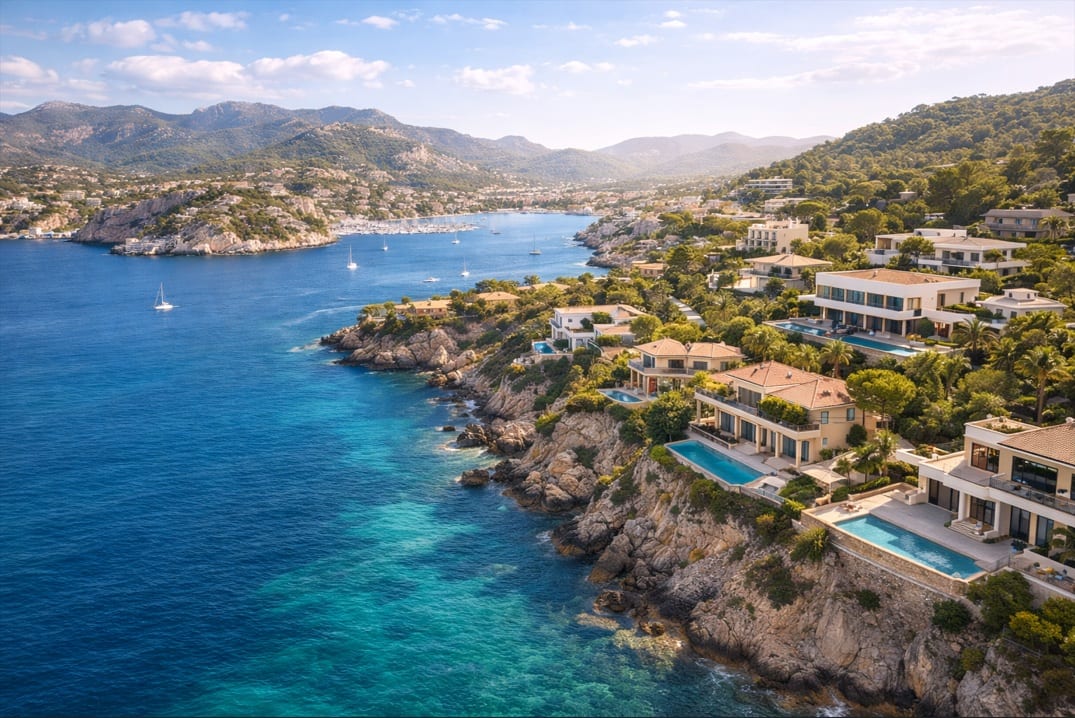
Geopolitical Context: Why a Possible Break in Relations Is Being Discussed
In early March 2026, global markets suddenly found themselves discussing a new potential risk: the possibility of a serious economic conflict between the United States and Spain. The discussion emerged after statements from U.S. President Donald Trump, who publicly suggested that the United States could reconsider economic relations with Spain, including the possibility of halting trade.
The statement was unusually direct. According to media reports, the American leader suggested that the United States could “have nothing to do with Spain” and even “stop all trade” with the country.
(The data are based on reports from international media.)
It is important to emphasize a key point: at the time of writing, these comments remain political statements rather than actual economic policy. No trade embargoes or economic sanctions against Spain have been introduced, and most economists consider a full break in economic relations highly unlikely.
Nevertheless, the appearance of such rhetoric quickly entered the global economic conversation and raised questions among investors — including those evaluating opportunities in the Mallorca property market.
What Exactly Happened
According to international media reports, tensions followed a diplomatic disagreement between Washington and Madrid. In response, the U.S. administration indicated it might review economic relations with Spain, including trade and investment cooperation.
The Spanish government responded relatively calmly. Spain’s Minister of Economy stated that no concrete economic measures from the United States have been proposed so far, and that the situation currently remains limited to political rhetoric.
In other words, financial markets are reacting not to an actual economic crisis but to a hypothetical scenario being discussed in political and media circles.

How Important Is Trade Between the United States and Spain?
To understand the potential scale of the issue, it is useful to look at the economic data.
According to Spanish statistics and reports from El País, trade between Spain and the United States represents a meaningful but not dominant share of Spain’s international trade.
(The data are drawn from Spanish economic statistics sources and publications by El País.)
Indicator | Value |
|---|---|
Spain exports to the United States (2025) | ~€16.7 billion |
Share of US in Spanish exports | about 4.3% |
Main exported goods | olive oil, wine, industrial equipment |
Even in the hypothetical case of a trade conflict, the United States would remain an important but not critical market for Spain. The majority of Spanish trade still takes place within the European Union.
For comparison:
Trading Partner | Share of Spanish Exports |
|---|---|
European Union | ~63% |
United States | ~4% |
Latin America | ~7% |
These figures indicate that even serious trade restrictions would be unlikely to destabilize the Spanish economy.
Why Investors Are Paying Attention
Financial markets react not only to facts but also to expectations.
The economic rhetoric of the Trump administration has historically emphasized tougher trade policies. During previous periods of his presidency, the United States introduced tariffs on European goods, increased pressure on several trading partners, and expanded protectionist measures.
According to economic studies, the total scope of tariffs introduced during Trump’s second presidency could affect more than $1.4 trillion in global trade flows.
(The data are based on economic research and international analytical publications.)
For this reason, investors take such statements seriously—even when the probability of full implementation remains relatively low.
Europe’s Response
So far, the European response has been measured.
First, trade policy between the United States and Europe is negotiated at the level of the European Union, not individual countries. Any major change to trade rules would therefore require negotiations with Brussels.
Second, European officials have already indicated that they do not support targeted economic sanctions against Spain and continue to view US–EU relations as a strategic partnership.
In practical terms, this means that any potential trade conflict would likely become a negotiation between the United States and the European Union, rather than a bilateral dispute with Spain alone.
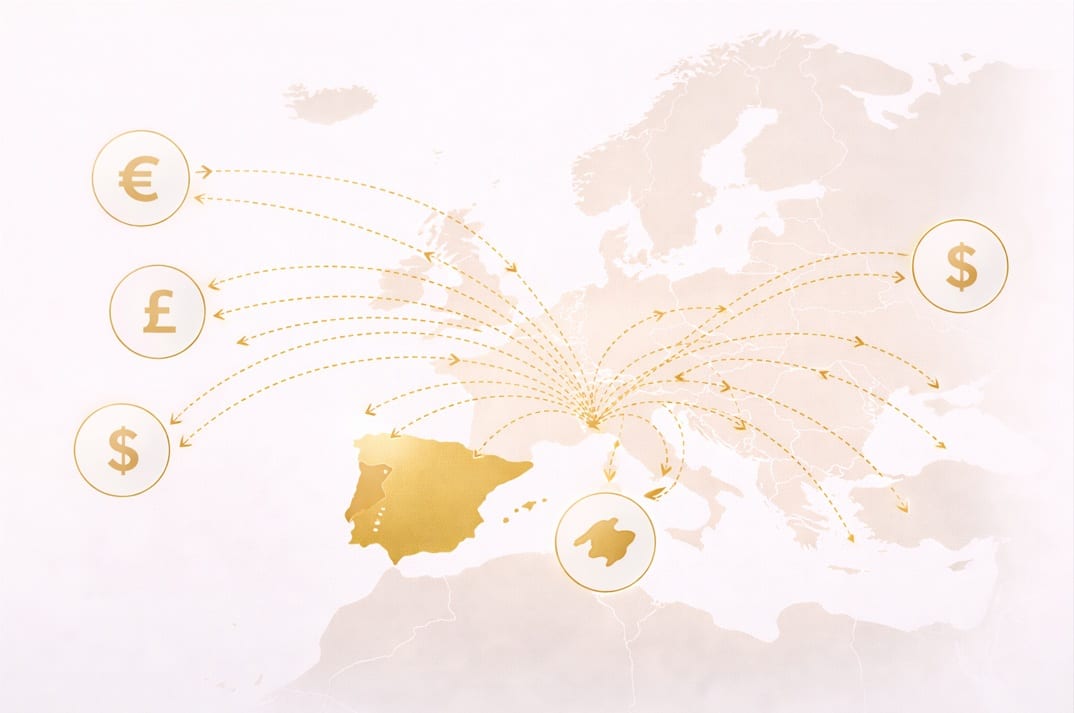
Why Real Estate Investors Are Watching Closely
At first glance, trade disputes between governments may appear unrelated to property markets. In reality, geopolitics and real estate investment are closely connected.
Geopolitical uncertainty can influence:
currency markets
international investment flows
investor confidence
cost of capital
This is particularly relevant for regions where property is heavily purchased by international buyers. The Mallorca real estate market is one of the most internationally driven property markets in Europe.
According to Spain’s property registry, approximately 35% of real estate transactions in the Balearic Islands involve foreign buyers.
(The data are based on statistics from the Spanish Property Registry)
The most active investors traditionally come from Germany, the United Kingdom, Switzerland and Scandinavian countries. In recent years, demand from American buyers has also increased.
Read our detailed article:
The New York Effect: Why Mallorca is the New Luxury Hub for Global Investors
This trend reflects the growing perception of Mallorca real estate as an international investment asset rather than a purely domestic housing market.
A Key Point for Investors
Even if a hypothetical trade conflict between the United States and Spain were to emerge, it would not automatically lead to a collapse of the Mallorca property market.
Several structural factors explain this:
the majority of property buyers in Mallorca are European
the luxury real estate segment is driven by international capital
land supply on the island is strictly limited
“Read our detailed article: Mallorca Real Estate Market 2026: Prices, Forecast & Investment Guide
For this reason, many analysts interpret the current political rhetoric primarily as diplomatic positioning rather than the beginning of a real economic conflict.
Nevertheless, these developments highlight an important reality: global politics can influence international investment flows. During periods of uncertainty, investors tend to focus on property markets with genuine long-term resilience.
To fully understand the potential implications for property investment in Mallorca, it is also necessary to examine another factor currently being discussed by global markets — possible instability in oil prices and its impact on the European economy and the Mallorca real estate market.
Possible Oil Market Instability and Rising Prices: Why Investors Are Watching the Energy Market
While political discussions currently focus on potential economic tensions between the United States and Spain, global markets are simultaneously facing another source of uncertainty — a sharp increase in geopolitical risks affecting the energy sector. For many analysts and investors, this factor is currently even more significant than political rhetoric.
In late February and early March 2026, the global oil market became increasingly volatile following tensions around the Strait of Hormuz, one of the most strategically important shipping routes in the world. Approximately 20% of global oil supply and a large share of liquefied natural gas shipments pass through this corridor.
Any disruption in this region tends to affect global energy markets almost immediately, influencing inflation expectations, transportation costs and economic forecasts worldwide.
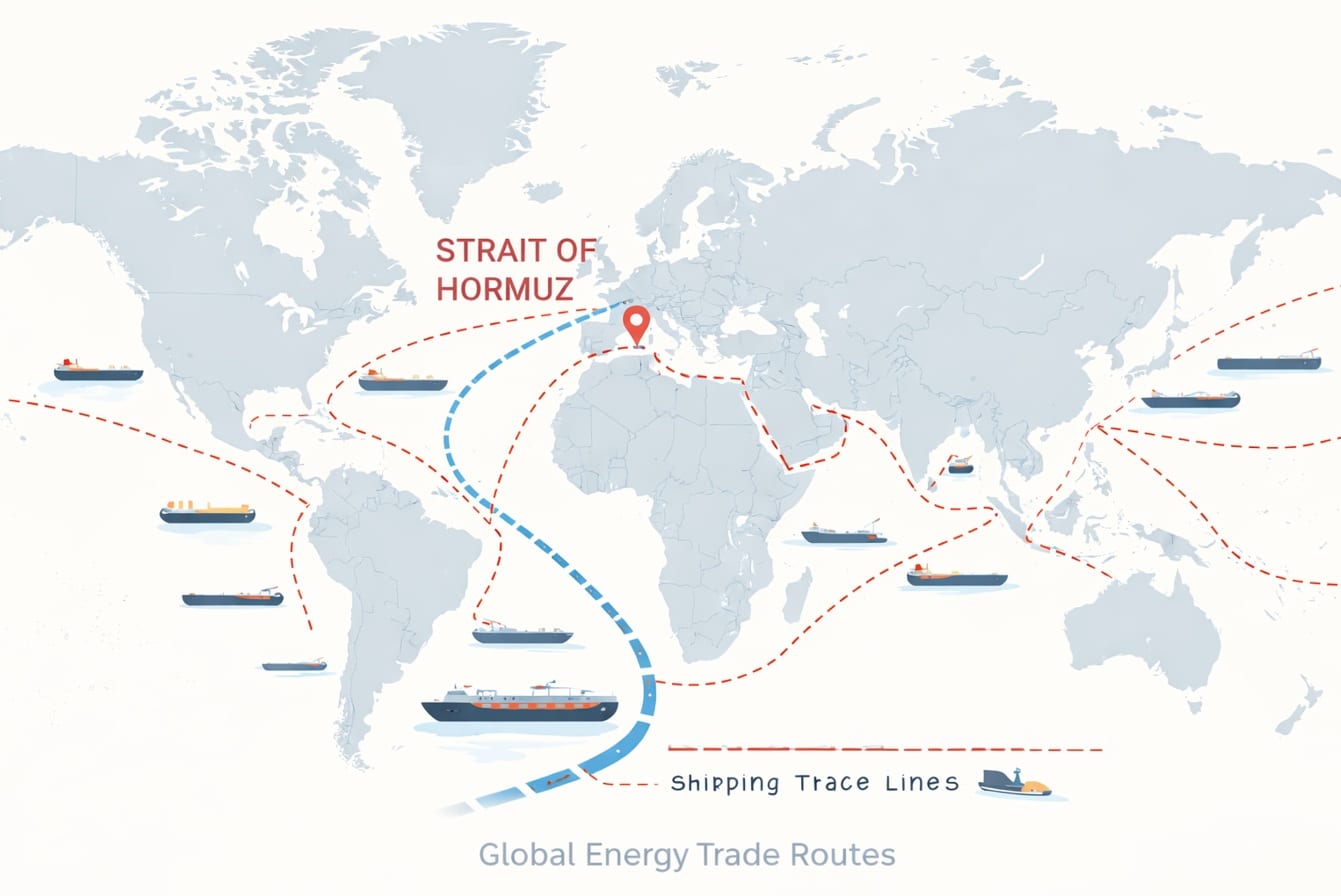
Global oil shipping routes highlighting the strategic importance of the Strait of Hormuz.
Why the Oil Market Is Currently So Unstable
According to energy market analysts, tanker traffic through this critical corridor has recently declined sharply. On some days only a few vessels have passed through the route, whereas under normal conditions dozens of tankers cross the strait daily.
Shortly after the tensions escalated, Brent crude oil prices increased by approximately 10–13%, reaching a range of around $80–82 per barrel.
Some analysts suggest that if supply disruptions were to persist, oil prices could approach $100 per barrel or even higher.
This is not merely a short-term market reaction. Oil remains one of the central pillars of the global economy, and any disruption in supply chains quickly affects inflation, transportation costs, and the price of industrial production.
Brent Oil Price – global benchmark influencing inflation, construction costs and international real estate markets.
What International Energy Organizations Are Saying
Analysis from major international institutions confirms that the energy market remains extremely sensitive to geopolitical developments.
According to the International Energy Agency (IEA), the global energy system is currently experiencing a period of increased instability in which geopolitical events directly affect the balance between supply and demand.
Meanwhile, OPEC forecasts continued growth in global oil demand over the coming years, making the market even more vulnerable to supply disruptions.
Analysts from the World Bank also emphasize that energy prices historically represent one of the most powerful drivers of global inflation.
The data are based on analytical publications from the International Energy Agency, OPEC, and the World Bank.
For this reason, economists closely monitor developments in the oil market. Energy crises rarely remain isolated regional events — they tend to spread across the global economy.
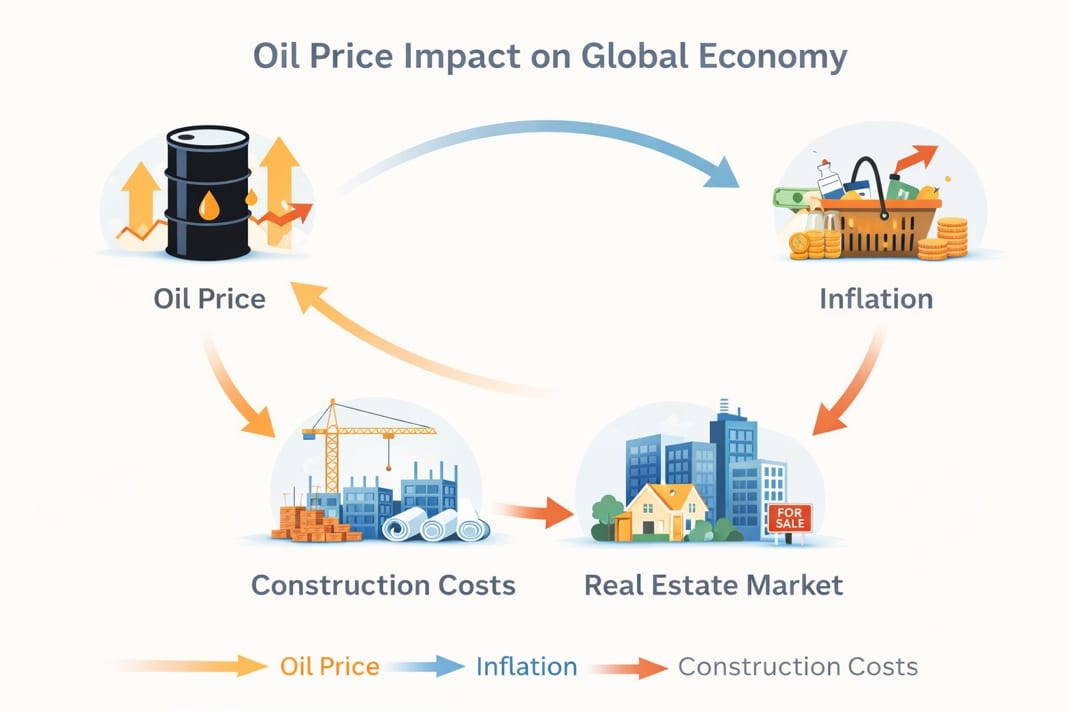
Why Rising Oil Prices Almost Always Lead to Higher Inflation
The relationship between oil prices and inflation is straightforward.
When oil becomes more expensive, the cost of many essential economic activities rises, including:
fuel
transportation of goods
industrial production
international logistics
As a result, price increases ripple through the entire economy.
According to economic estimates, a sustained increase in oil prices could add up to 0.8% to global inflation levels.
Europe is particularly sensitive to this dynamic.
Unlike the United States, which is a major producer of oil and gas, many European countries remain net importers of energy. As a result, energy shocks tend to have a stronger impact on the European economy.
Why Energy Crises Matter for the Real Estate Market
At first glance, oil prices and real estate might appear unrelated. In reality, the connection between the energy sector and property markets is significant.
There are several main transmission channels.
1. Inflation and Interest Rates
When inflation accelerates, central banks are often forced to maintain higher interest rates.
Higher borrowing costs make mortgages more expensive, which can reduce housing affordability and slow property markets.
2. Construction Costs
Energy represents one of the key inputs in construction.
Oil prices influence:
cement production
steel manufacturing
transportation of building materials
heavy construction equipment
When energy prices increase, the cost of building new housing rises, often reducing the overall supply of new properties.
3. Capital Flows into Real Assets
Historically, periods of geopolitical instability and energy crises often lead to increased interest in hard assets.
These include:
real estate
land
infrastructure
precious metals
As a result, many investors view real estate investment as a hedge against inflation.
Why This Matters for the Mallorca Real Estate Market
For global investors, energy market instability often triggers a reallocation of capital.
When financial markets become volatile, investors tend to seek stable and limited assets.
This is where the Mallorca real estate market becomes particularly interesting.
Unlike many other European regions, property in Mallorca is characterized by several structural advantages:
limited land supply
strong international demand
a dominant luxury real estate segment
a high share of buyers from Europe and North America
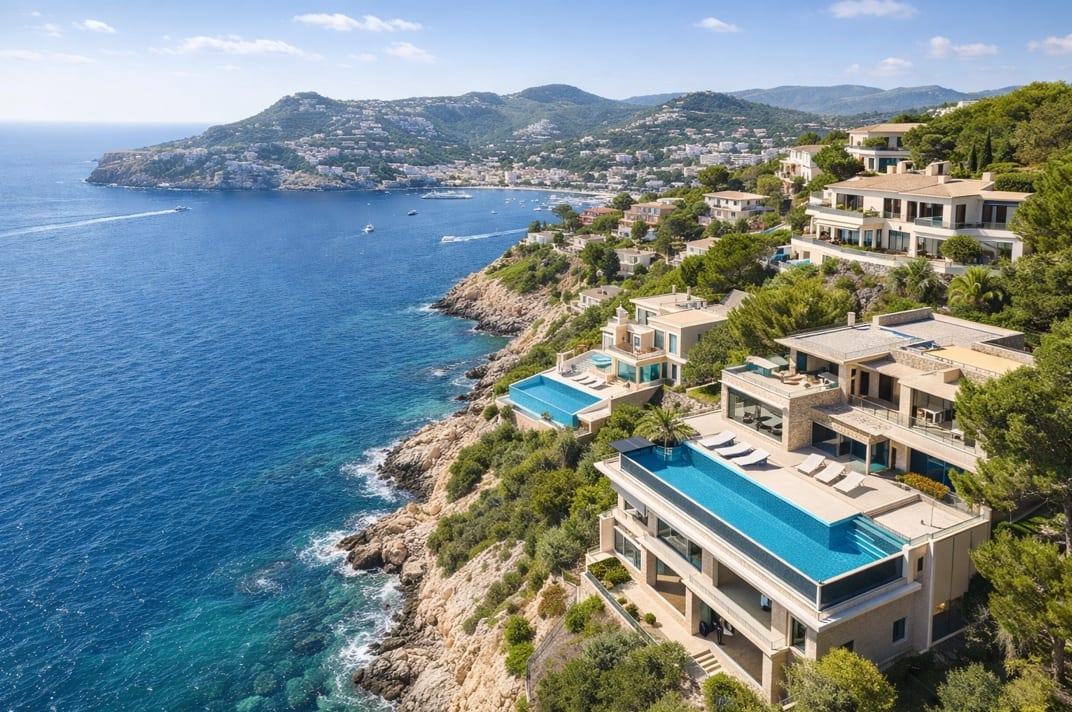
According to market analysis by Aventin Real Estate, discussed in the research report:
Mallorca Real Estate Market 2026: Prices, Forecast & Investment Guide
premium Mallorca real estate has historically demonstrated resilience even during periods of global economic turbulence.
Read our detailed article: Mallorca Real Estate Market 2026: Prices, Forecast & Investment Guide
In recent years, the island has also attracted increasing amounts of international capital. This phenomenon has even been described as the “New York Effect.”
Read our detailed article: The New York Effect: Why Mallorca is the New Luxury Hub for Global Investors
The concept is simple: during periods of global uncertainty, investors tend to focus on safe, prestigious locations for long-term property investment.
Mallorca is increasingly becoming one of those locations.
What This Means for Investors
The combination of geopolitical rhetoric and potential instability in global energy markets increases overall uncertainty in the global economy.
However, history reveals an interesting pattern.
During periods of global economic turbulence, premium real estate often does not decline — it becomes more desirable.
This is particularly true for limited markets with strong international demand, such as the Mallorca property market.
For investors considering property investment in Mallorca, the more relevant question is not whether global uncertainty exists, but how resilient specific real estate markets are during periods of economic stress.
To understand this resilience, it is useful to examine how previous global crises have historically affected the real estate market.
How Global Crises Typically Affect the Real Estate Market
History shows that real estate markets do not react to global crises in the same way. Mass housing markets are often highly sensitive to economic shocks, while premium real estate in international destinations — such as the Mallorca real estate market — tends to behave differently.
A good example is the global financial crisis of 2008. Across Spain, housing prices fell by more than 30% over several years. However, the decline mainly affected mass residential developments on the mainland, where housing supply had significantly exceeded demand.
In the Balearic Islands, the situation was noticeably different. Limited land availability and strong international demand allowed the Mallorca property market to recover much faster than many other regions in Spain.
A similar pattern appeared during the COVID-19 pandemic. At the beginning of 2020 many analysts expected property prices to fall sharply across Europe. However, the opposite happened in Mallorca. By 2021 demand for houses and villas in Mallorca increased significantly, particularly among buyers from Germany, Switzerland, the United Kingdom and Northern Europe.
For many international investors, property in Mallorca became more than an investment. It also represented an opportunity to diversify assets while improving quality of life.

Another example can be seen during the recent inflationary cycle in Europe. As interest rates began to rise, many European housing markets slowed down. However, the luxury real estate Mallorca segment continued to demonstrate resilience.
The explanation lies largely in the structure of buyers. A significant portion of transactions in the premium segment are completed without mortgage financing, making the market less dependent on bank interest rates.
As a result, a consistent pattern has emerged:
During periods of global economic uncertainty, premium real estate in limited and prestigious locations often preserves value better than the mass housing market.
This is why, when analyzing potential geopolitical or energy crises, it is important to understand that the Mallorca real estate market belongs to a category of international premium markets, where long-term investment, limited supply and global demand play the key role.
Why the Mallorca Real Estate Market Is Different
To understand why geopolitical news or economic crises rarely have a destructive effect on the Mallorca property market, it is important to look at the unique structure of this market. In many ways, it differs fundamentally from most regions in Spain and Europe.
The first factor is limited land supply.
Mallorca is an island, which means its territory cannot physically expand. In addition, large parts of the island are protected natural areas where construction is strictly regulated. New building permits are issued very cautiously.
As a result, the supply of real estate in Mallorca grows slowly, while demand remains consistently strong. This imbalance between supply and demand is one of the main drivers of long-term price growth.
The second factor is the international status of the island.
Over the past decades Mallorca has become one of the most prestigious destinations in Europe not only for tourism but also for living and investment. The island attracts entrepreneurs, investors, executives and business owners who purchase property in Mallorca as second homes or long-term investment assets.
Luxury Real Estate: Exclusive Estates & Mansions in Mallorca
The third factor is international demand.
According to Spanish property registries, foreign buyers represent approximately 30–35% of all real estate transactions in the Balearic Islands, and their share is even higher in the premium segment.
The most active buyers come from:
Germany
United Kingdom
Switzerland
Scandinavia
Netherlands
Finally, the structure of capital also plays a major role.
A large portion of luxury real estate Mallorca transactions are completed by high-net-worth buyers without mortgage financing. This makes the market significantly less dependent on banking cycles, interest rates and short-term economic fluctuations.
Taken together, these factors lead to an important conclusion for investors:
the Mallorca real estate market has a strong structural protection from external economic shocks, because its foundation is built on limited supply and global demand from wealthy buyers.
Obvious Effects on the Mallorca Real Estate Market
If geopolitical tensions or energy instability were to affect the European economy, the Mallorca property market would likely respond differently across price segments. This segmented reaction is typical for most international real estate markets.
Entry-Level Segment
The most sensitive category is typically the entry-level housing segment — smaller apartments and properties primarily purchased by local residents.
Buyers in this category usually rely on mortgage financing and therefore are more affected by:
interest rates
inflation
general economic conditions
If energy prices increase inflation and interest rates remain high across Europe, demand in the entry-level segment could temporarily decline. In such a scenario, the market may experience price stabilization or moderate downward pressure.
Apartments and Penthouses for Sale in Mallorca
Mid-Market Segment
The mid-market segment of the Mallorca real estate market, typically properties priced between €500,000 and €1.5 million, tends to show greater resilience.
In this category, a large share of buyers are international investors purchasing property in Mallorca as a second home or long-term investment.
Even during periods of economic uncertainty, demand in this segment often remains relatively stable, as buyers perceive Mallorca as a safe European location for lifestyle and capital preservation.
Houses and Detached Homes for Sale in Mallorca
Luxury Segment
The most interesting dynamics can be observed in the luxury real estate Mallorca segment — villas, penthouses and coastal residences valued at several million euros.
Historically this segment has demonstrated the highest resilience during global crises.
The reason is relatively simple: during periods of geopolitical uncertainty, wealthy investors often move capital into real assets located in prestigious and limited destinations.
As a result, if global economic turbulence increases, demand for luxury property in Mallorca may not only remain stable but in some cases even grow.
Less Obvious Consequences
Geopolitical and economic instability can sometimes produce effects that are not immediately obvious but still have a meaningful impact on the Mallorca real estate market.
First, during periods of global uncertainty interest often increases in stable and prestigious European locations. For many investors, Mallorca is perceived as a secure jurisdiction with high quality of life, strong infrastructure and limited property supply. This perception can increase interest in buying property in Mallorca.
Second, capital relocation may occur. When financial markets become more volatile, some investors prefer moving funds into real assets, particularly real estate.
Finally, the island has recently seen a growing number of entrepreneurs, investors and executives relocating to Mallorca. Remote work and international mobility have made it easier for professionals to live outside traditional business centers.
Economic uncertainty in other regions may accelerate this trend, further increasing demand for high-quality residential real estate in Mallorca.
Why the Mallorca Real Estate Market Is Unlikely to Collapse
When global economic risks are discussed, a common question arises: could one of Europe’s most famous resort property destinations — the Mallorca real estate market — suffer serious damage?
In practice, such a scenario appears unlikely for a simple reason: a significant portion of property in Mallorca is already owned by wealthy international investors.
In other words, a dramatic market collapse would effectively represent “friendly fire” — a situation where the same investors who drive demand for the island’s real estate would also suffer the losses.
Today many owners of Mallorca real estate belong to the European and international business elite: entrepreneurs, investors, executives and company founders.
German capital plays a particularly important role. For decades, Germany has remained one of the largest sources of buyers purchasing property in Mallorca and across the Balearic Islands.
British buyers also represent a major share of the market. Many of them consider Mallorca a second home destination.
In recent years, interest from American investors has also increased significantly, with more buyers purchasing luxury villas and apartments in Mallorca.
As a result, the island has developed a unique market structure: Mallorca property has become part of the global investment portfolios of wealthy individuals.
This is one of the key reasons why deep and prolonged price collapses occur far less frequently here than in mass housing markets.
Three Possible Scenarios
Since the economic and energy risks currently being discussed remain hypothetical, analysts typically consider several potential scenarios.
Each of them would affect the Mallorca property market in different ways.
Scenario 1: Political Rhetoric Without Real Economic Measures
The most likely scenario is that the situation remains limited to political statements and diplomatic discussions.
If this happens, global markets will quickly adapt and the Mallorca real estate market will likely remain largely unaffected.
International demand for property in Mallorca would remain stable and the market would continue to develop at its current moderate pace.
Scenario 2: Partial Economic Conflict
If trade restrictions between the United States and Europe were introduced, or if economic uncertainty increased, financial markets could experience short-term volatility.
In such a scenario some investors might adopt a wait-and-see approach.
However, for the Mallorca real estate market, this would likely result in a temporary slowdown in transactions rather than a significant drop in prices.
Scenario 3: A More Serious Global Crisis
Even in the case of a larger global economic crisis, historical experience suggests that premium real estate in limited locations tends to remain relatively resilient.
During periods of geopolitical uncertainty, wealthy investors often move capital into real assets.
For this reason, luxury real estate Mallorca — including villas, penthouses and coastal residences — may maintain stability better than mass housing markets.
Luxury Real Estate: Exclusive Estates & Mansions in Mallorca
Pros and Cons for Buyers and Property Owners in Mallorca
Global economic turbulence does not affect only markets — it also affects individuals.
For those considering buying property in Mallorca as a place to live or a long-term investment, geopolitical and energy risks may bring both advantages and challenges.
Below is a simplified comparison of potential effects for property owners and buyers.
Potential Advantages | Potential Risks |
|---|---|
Increased interest in stable European destinations such as Mallorca | Possible short-term decline in tourism |
Capital shifting into real assets such as real estate | Higher construction and renovation costs due to expensive energy |
Growing demand for high-quality residential property | Higher maintenance costs for property owners |
Increased interest from international investors | Economic uncertainty in Europe |
For many buyers, Mallorca real estate remains a long-term asset combining investment value with exceptional lifestyle benefits.
Advice for Buyers Considering Property in Mallorca
For investors thinking about buying property in Mallorca, periods of global uncertainty are not necessarily a reason to postpone decisions.
In many cases such periods simply require a more strategic approach to investment.
Focus on Long-Term Investment
Historically, the Mallorca real estate market has shown resilience over the long term. Short-term fluctuations rarely affect the long-term value of high-quality properties.
Diversify Your Investment Portfolio
Buying property in Mallorca can form part of a broader capital preservation strategy. Many investors consider real estate a reliable hedge during periods of financial market volatility.
Choose Premium Locations
Location remains the most important factor.
Areas with limited supply and strong international reputation — such as coastal zones, prestigious districts of Palma de Mallorca, or the southwest Mallorca region — typically demonstrate the highest resilience.
Real Estate in Southwest Mallorca: The Island’s Most Exclusive Coast
Real Estate in Palma de Mallorca: From Old Town to Seafront
In times of global uncertainty, high-quality real estate in prime locations often remains one of the most reliable assets available to investors.
Advice for Property Sellers in Mallorca
For owners planning to sell property in Mallorca, periods of global uncertainty require a slightly more strategic approach.
However, it is important to remember that demand for quality properties on the island is still largely driven by international buyers.
Realistic Pricing Strategy
Pricing should reflect current market conditions and comparable listings. Overpriced properties may stay on the market longer, while correctly positioned homes attract serious buyers faster.
High-Quality Marketing
Professional photography, video tours and well-written property descriptions are essential, especially when buyers evaluate Mallorca real estate remotely from abroad.
International Audience
Demand for property in Mallorca largely comes from international investors. Effective sales strategies often include global marketing platforms and multilingual communication.
Even during economic uncertainty, well-presented properties in strong locations continue to attract buyers.
Conclusion
Despite current geopolitical discussions and potential energy market volatility, most structural factors indicate that the Mallorca real estate market remains one of the most resilient property markets in Europe.
Limited land supply, the island’s international reputation and stable demand from wealthy international buyers create a strong foundation for long-term stability.
Even during periods of global uncertainty, premium real estate in limited locations tends to perform better than mass housing markets.
Mallorca belongs to this category of markets. It attracts global capital, entrepreneurs and investors who see property in Mallorca not only as an investment but also as a lifestyle asset.
For long-term investors, the key question today is therefore not short-term political news but the fundamental factors that support the Mallorca property market — and those factors remain strong.
Will property prices in Mallorca drop in 2026?
No. Due to limited supply, strong international demand and a high share of cash buyers, the Mallorca real estate market is expected to remain stable with moderate growth.
What is the forecast for Mallorca property prices until 2028?
Experts expect annual growth of 3–7%, with the luxury segment outperforming the mid-market. Premium locations in Southwest Mallorca are likely to remain particularly strong.
Is buying property in Mallorca a good investment?
Yes. Mallorca is considered one of Southern Europe’s most resilient property markets, supported by international buyers and long-term capital demand.
Which areas in Mallorca are most attractive for investors?
Son Vida, Port d’Andratx, Bendinat, Santa Ponsa, Cala Vinyes and central Palma are among the most sought-after areas for both lifestyle buyers and investors.
What rental yields can investors expect in Mallorca?
Properties with a valid tourist rental license can generate gross yields between 7% and 12%, depending on location and property type.
Expert Commentary from Aventin Real Estate
According to the team at Aventin Real Estate, the Mallorca real estate market remains stable despite increased media discussion of global economic risks.
At the beginning of 2026, international buyer demand continues to remain strong. Particularly active investors come from Germany, Switzerland, the United Kingdom and Northern Europe.
Interest from American buyers has also been growing, with many investors viewing Mallorca as an alternative to other premium Mediterranean destinations.
In the luxury real estate Mallorca segment, limited supply of high-quality properties remains the key factor supporting prices.
Many wealthy buyers are specifically searching for long-term investments and safe assets.
Looking ahead to the next 12–24 months, our expectation is continued stable demand for premium properties, particularly in the most desirable areas of the island.
In the medium term, Mallorca is likely to further strengthen its position as one of Europe’s leading destinations for international real estate investment.
Contact us today and invest in Mallorca the right way.
Property for Sale in Mallorca – Explore by Type and Location
To explore more property opportunities in Mallorca, browse our main categories below.
Whether you are looking to buy property in Mallorca, find villas for sale, explore apartments in Mallorca or discover new developments and investment properties, you will find carefully selected listings across the island’s most desirable areas such as Palma, Santa Ponsa, Cala Vinyes and Southwest Mallorca.
Start exploring Mallorca properties and find your perfect home today.
General Listings | Property Types | The Most Popular Locations | ||
|---|---|---|---|---|
Author: Aventin Real Estate Experts