Introduction
Selling property in Mallorca is not only about finding a buyer and negotiating the final price. For property owners, it is equally important to understand what taxes and costs apply when selling property in Spain, how these taxes are calculated, and what financial obligations arise after the transaction is completed.
Many homeowners only discover certain expenses at the moment of signing the deed of sale at the notary’s office. However, proper financial preparation for selling property in Mallorca should begin much earlier. Understanding the potential taxes when selling property in Spain allows owners to estimate their net proceeds from the sale and avoid unexpected costs.
In Spain, the process of selling real estate involves several taxes and mandatory expenses. These include Capital Gains Tax in Spain, the municipal Plusvalía tax, possible 3% retention tax for non-resident sellers, as well as additional transaction costs ranging from bank fees to notary services and real estate agency commissions.
Understanding the structure of property selling costs in Spain allows owners to calculate the real profit from their property sale and plan the transaction more effectively. In this guide, the experts at Aventin Real Estate Mallorca explain in detail what taxes you pay when selling property in Mallorca, what expenses may arise before and after the sale, and how property owners can prepare properly for a successful transaction.
Taxes and Costs When Selling Property in Spain
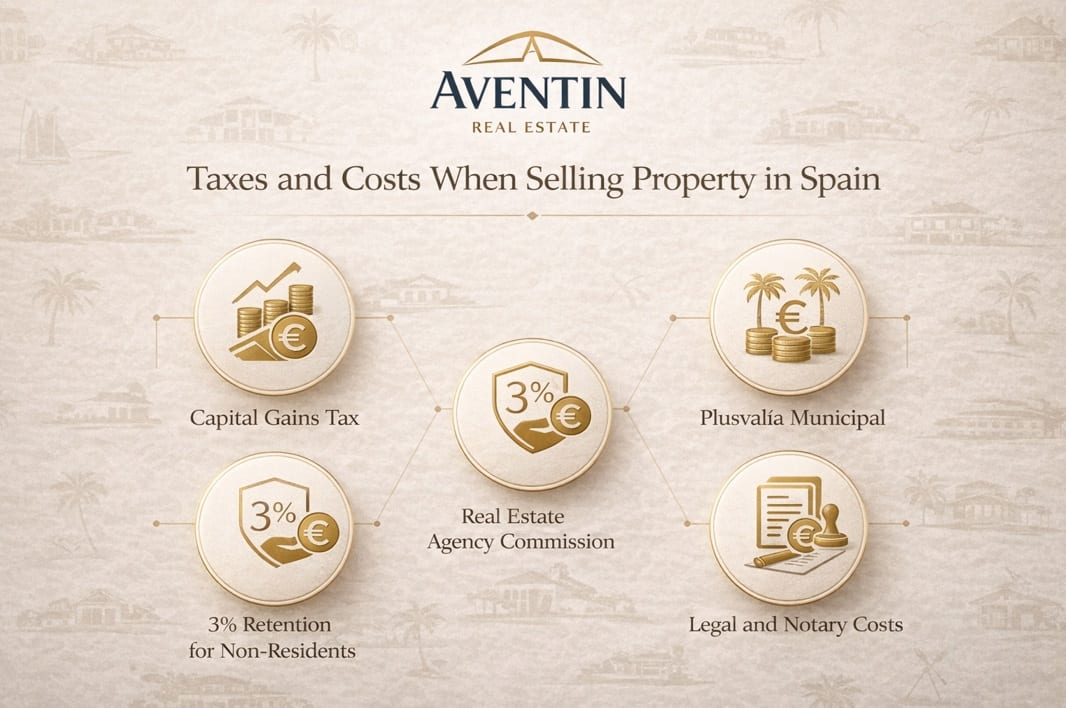
When selling property in Spain, the owner does not face just one tax but rather a combination of several mandatory payments. Unlike some countries where tax obligations only arise after profits are realised, the Spanish system includes different types of taxes connected both to the transaction itself and to the increase in the property's value over time.
The main taxes when selling property in Mallorca include Capital Gains Tax (Impuesto sobre la Ganancia Patrimonial) and the municipal Plusvalía tax, which is charged on the increase in the value of the land on which the property is located.
If the seller is not a tax resident of Spain, an additional mandatory withholding tax known as 3% Retención applies. In this case, the buyer must retain 3% of the property sale price and transfer this amount directly to the Spanish tax authority (Agencia Tributaria) as a guarantee of the seller’s tax obligations.
In addition to these taxes, there are also several transaction-related costs involved in selling property in Spain. These may include notary fees, land registry charges, bank costs related to mortgage cancellation, obtaining an energy certificate, and the commission of a real estate agency managing the sale.
It is important to understand that the total cost of selling a property in Spain can significantly influence the final profit from the transaction. For this reason, professional planning and a clear understanding of property selling taxes and costs in Mallorca help sellers determine the real financial outcome of the sale before the transaction takes place.
Below is a simplified overview of the main taxes and expenses that property owners may face when selling property in Spain.
Main Taxes and Costs When Selling Property in Spain
Type of tax or expense | What it is | Who pays | When it is paid |
|---|---|---|---|
Capital Gains Tax | Tax on profit from the increase in property value | Seller | After filing the tax declaration |
Municipal Plusvalía Tax | Tax on the increase in the value of the land | Seller | Usually after the sale |
3% Retention Tax (Retención) | Withholding tax for non-resident sellers | Buyer withholds | At the moment of the transaction |
Real Estate Agency Commission | Payment for property marketing and sales services | Seller | After completion of the sale |
Notary and Registry Costs | Legalisation and registration of the transaction | Usually buyer, but negotiable | On the day of signing |
Energy Certificate | Mandatory document required for property sale | Seller | Before listing the property |
Costs Before Selling Property
Before listing a property on the market, homeowners in Mallorca should consider a number of preparatory expenses. These costs are often overlooked by property owners, yet they can significantly influence both the speed of the sale and the attractiveness of the property to potential buyers. Proper preparation of the property not only helps sell property in Mallorca faster, but in many cases also allows owners to achieve a higher sale price.
One of the mandatory documents required when selling property in Spain is the Energy Performance Certificate (Certificado de Eficiencia Energética). Without this certificate, the property cannot be legally advertised or sold. In addition, the owner may need to update certain legal documents related to the property, such as the nota simple from the Land Registry, which confirms the legal status and ownership of the property.
In some cases, sellers also invest in minor cosmetic improvements before listing their property. These may include refreshing interior paint, improving lighting, or preparing the property for viewings. Such preparation is common in the Mallorca real estate market, particularly when selling luxury villas or premium apartments where presentation can strongly influence buyer interest.
Many property owners also order a professional property valuation in Mallorca to determine the realistic market price of the property. A professional valuation helps establish a competitive listing price and can significantly shorten the time required to sell the property.
To receive a professional property valuation from Aventin Real Estate, click the “Free Valuation” button in the bottom right corner of the screen.
Our specialists will contact you shortly and explain how you can sell your property in Mallorca profitably, quickly, and securely.
Main Expenses Before Selling Property
Type of expense | Description | When it occurs |
|---|---|---|
Energy Certificate | Mandatory document confirming the energy efficiency of the property | Before listing the property |
Land Registry Extract (Nota Simple) | Confirms ownership and legal status of the property | Before the sale |
Professional Property Valuation | Determines the realistic market value of the property | Before listing |
Property Preparation (Home Staging) | Cosmetic improvements and preparation for viewings | Before marketing begins |
Legal Consultation | Review of documents and preparation for the transaction | Before signing the contract |
Costs After Selling Property
After the completion of a property transaction and the signing of the deed of sale at the notary’s office, the seller may face several additional expenses and tax obligations. Many of these costs are directly related to the Spanish tax system and are calculated based on the profit generated from the sale of the property.
The most significant expense is usually Capital Gains Tax in Spain, which is calculated based on the difference between the purchase price of the property and its final sale price. The tax rate depends on the amount of profit generated from the sale and follows a progressive tax scale.
Another important tax is the municipal Plusvalía tax (Impuesto sobre el Incremento de Valor de los Terrenos de Naturaleza Urbana). This tax is paid to the local municipality and is calculated based on the increase in the value of the land during the period of property ownership.
If the seller is not a tax resident of Spain, the buyer must withhold 3% of the total sale price under the Retención tax rule and transfer this amount directly to the Spanish tax authority. After the transaction, the seller may file a tax declaration to determine the final tax liability and potentially recover part of the withheld amount if the actual tax due is lower.
In addition to these taxes, other expenses may arise, such as bank fees related to mortgage cancellation, as well as legal or tax advisory services required to properly complete the transaction.
Understanding these property selling costs in Spain allows sellers to calculate their real net profit from the sale and plan the financial outcome more accurately.
Main Costs After Selling Property
Type of expense | Description | Who pays |
|---|---|---|
Capital Gains Tax | Tax on profit from the sale of property | Seller |
Municipal Plusvalía Tax | Tax on the increase in land value | Seller |
3% Retention Tax | Applies to non-resident property sellers | Buyer withholds |
Bank Fees | Mortgage repayment and money transfers | Seller |
Legal Services | Preparation of documents and tax declarations | Seller |
Municipal Land Value Increase Tax (Plusvalía Municipal)
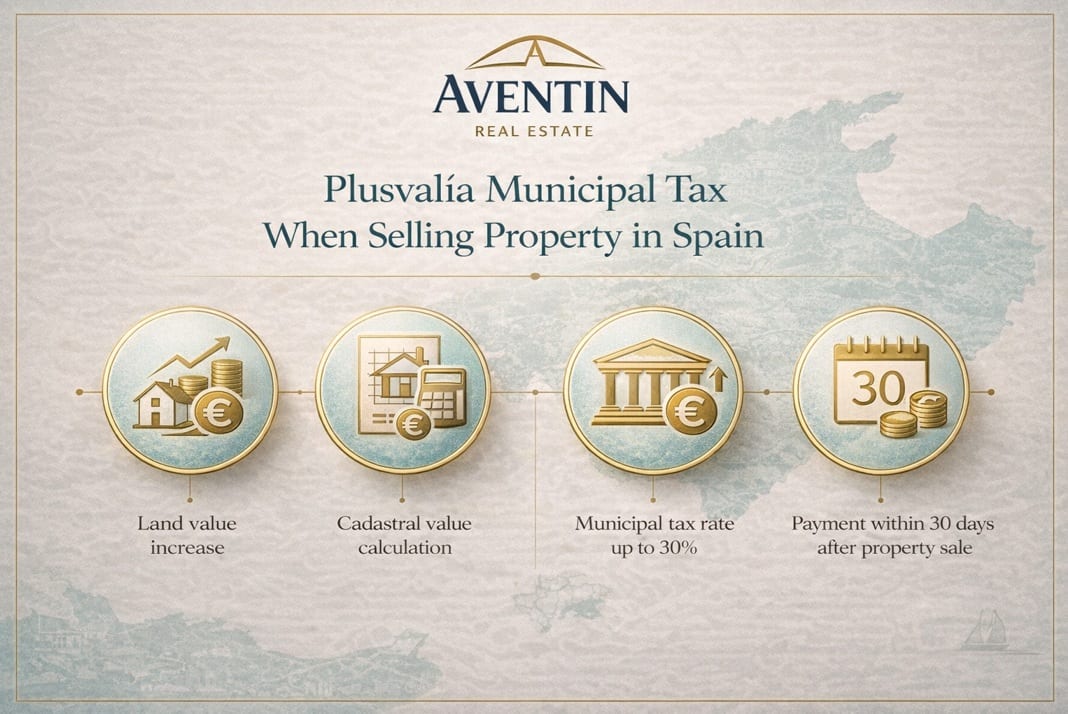
One of the mandatory taxes when selling property in Mallorca is the municipal tax on the increase in land value known as Plusvalía Municipal. Its official name in Spanish legislation is Impuesto sobre el Incremento de Valor de los Terrenos de Naturaleza Urbana (IIVTNU).
This tax is levied by the municipality (Ayuntamiento) and is calculated based on the increase in the cadastral value of the land on which the property is located. It is important to understand that Plusvalía applies only to the value of the land, not to the value of the building, house, or apartment itself.
The tax is regulated by Real Decreto-ley 26/2021, which was adopted after the Spanish Constitutional Court ruled the previous calculation system unconstitutional. As a result, a new calculation model was introduced, allowing taxpayers to choose the most favourable method for calculating the Plusvalía tax.
The Plusvalía tax in Spain applies in several situations:
- sale of property
- property donation
- inheritance of property
When selling property in Spain, the tax is usually paid by the seller, unless otherwise agreed in the purchase contract.
The deadline for paying this tax is:
Situation | Payment deadline |
|---|---|
Sale of property | 30 calendar days |
Inheritance of property | 6 months (with possible extension) |
The maximum tax rate is set by the municipality and cannot exceed 30% of the taxable base according to Spanish tax legislation.
Approximate Plusvalía Municipal Tax Rates in Mallorca
Municipality | Plusvalía tax rate |
|---|---|
Palma de Mallorca | about 18% |
Calvià | 25% – 30% |
Andratx | about 14% – 29% |
Alaró | about 26% |
Alcúdia | about 22% |
Algaida | about 8.1% |
Ariany | about 20% |
Escorca | about 26% |
Esporles | about 26% |
Estellencs | about 20% |
Felanitx | about 22.37% |
Fornalutx | up to 30% |
Inca | about 25% |
Puigpunyent | about 26% |
Sa Pobla | about 16% |
Sant Joan | about 20% |
Sant Llorenç des Cardassar | about 22% |
Santa Eugènia | about 12% |
Santa Margalida | about 22% |
Source of data: municipal tax ordinances and cadastral Plusvalía calculations for municipalities in Mallorca.
The exact amount of Plusvalía tax when selling property in Mallorca depends on several factors:
- the cadastral value of the land
- the length of property ownership
- the municipal tax rate set by the local authority
How the Plusvalía Tax Is Calculated
After the reform of Spanish tax legislation, property sellers gained the possibility to choose between two different methods for calculating Plusvalía tax. This change was introduced to ensure that the tax reflects the real increase in land value, rather than purely theoretical indicators.
The municipality must accept the lower of the two calculated results, provided that the taxpayer submits supporting documentation.
Method 1 — Objective Calculation (Based on Cadastral Value)
This method is based on the cadastral value of the land (valor catastral del suelo).
This value can be found on the annual IBI property tax receipt.
A coefficient depending on the length of property ownership is applied to the cadastral value.
Maximum coefficients currently applied in Spain (2026)
Holding period | Maximum coefficient |
|---|---|
Up to 1 year | 0.14 |
1 year | 0.13 |
2 years | 0.15 |
3 years | 0.16 |
4 years | 0.17 |
5 years | 0.17 |
6 years | 0.16 |
7 years | 0.12 |
8 years | 0.10 |
9 years | 0.09 |
10 years | 0.08 |
11–13 years | 0.08 |
14 years | 0.10 |
15 years | 0.12 |
16 years | 0.16 |
17 years | 0.20 |
18 years | 0.26 |
19 years | 0.36 |
20 years or more | 0.45 |
After applying the coefficient, the resulting taxable base is multiplied by the municipal tax rate, which usually ranges from 24% to 30% depending on the municipality.
Method 2 — Real Increase in Land Value
If the actual increase in land value is lower than the calculated cadastral value method, the seller may use an alternative calculation method.
Formula:
(Sale price – Purchase price) × land value share
The proportion of land value is determined based on cadastral data.
For example:
- land value — 60%
- building value — 40%
Example of a Plusvalía Tax Calculation
Let us consider a realistic example of selling property in Mallorca.
Parameter | Value |
|---|---|
Purchase price | €300,000 |
Sale price | €450,000 |
Cadastral value | €100,000 |
Land share | 60% |
Ownership period | 6 years |
Coefficient | 0.16 |
Municipal tax rate | 30% |
Step 1 — determine the cadastral land value
100,000 × 60% = €60,000
Step 2 — apply the ownership coefficient
60,000 × 0.16 = €9,600
This amount represents the Plusvalía taxable base.
Step 3 — apply the municipal tax rate
9,600 × 30% = €2,880
Final Plusvalía Tax
€2,880
Important Recommendation for Property Sellers
The cadastral value of land can be found:
- in the latest IBI tax receipt
- in the Spanish cadastral registry (Catastro)
- at the local municipality (Ayuntamiento)
Professional real estate agencies such as Aventin Real Estate often work with legal partners and specialised tax advisors who can recommend qualified lawyers capable of performing a preliminary tax calculation before selling property in Mallorca, allowing property owners to understand the expected net profit from the sale.

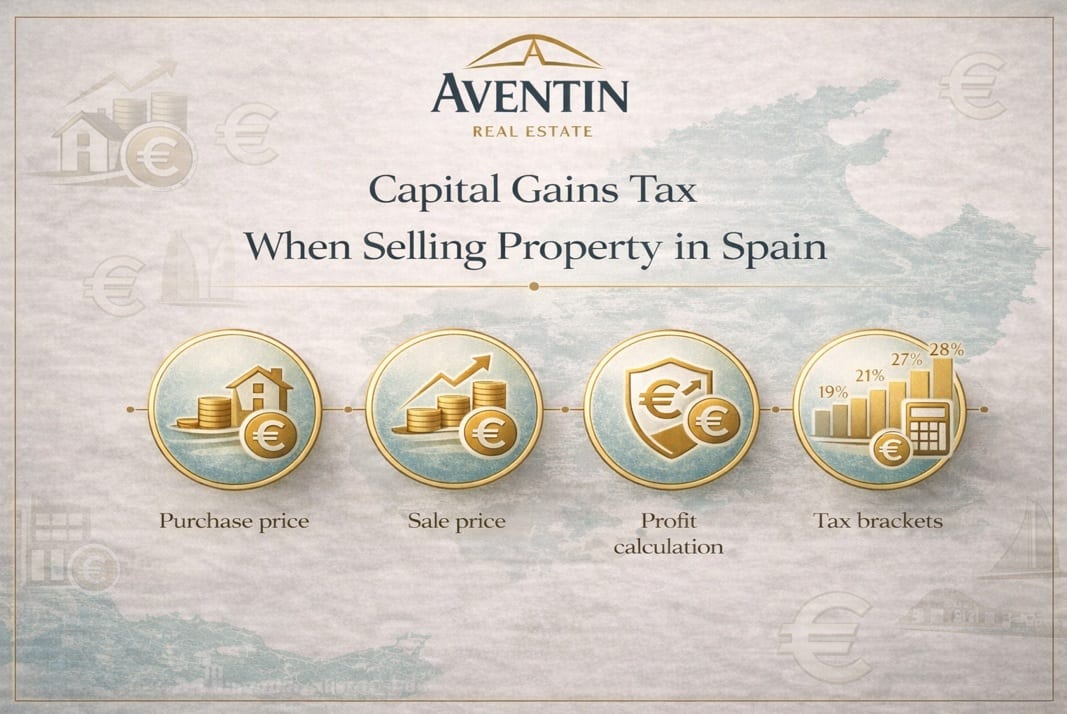
Capital Gains Tax When Selling Property in Spain
The second major tax that applies when selling property in Mallorca is Capital Gains Tax, which in Spain forms part of the personal income tax system. For Spanish tax residents it is regulated under IRPF (Impuesto sobre la Renta de las Personas Físicas), while for non-residents it falls under IRNR (Impuesto sobre la Renta de No Residentes).
This tax is calculated based on the difference between the purchase price and the sale price of the property. In simple terms, the tax is applied only to the profit obtained when selling property in Spain.
When calculating capital gains tax in Spain property sales, several factors are taken into account:
- the purchase price of the property
- the final sale price
- purchase costs (notary fees, property transfer tax, registration costs)
- documented capital renovation expenses
- real estate agency commission paid when selling the property
All these expenses may reduce the taxable profit when selling property in Spain.
It is important to note that capital gains tax rates differ for Spanish tax residents and non-residents.
Capital Gains Tax Rates in Spain (2026)
Profit Amount | Tax Rate for Residents |
|---|---|
Up to €6,000 | 19% |
€6,001 – €50,000 | 21% |
€50,001 – €200,000 | 23% |
€200,001 – €300,000 | 27% |
More than €300,000 | 28% |
For non-residents selling property in Spain, a fixed tax rate applies:
Seller Status | Tax Rate |
|---|---|
EU / EEA Non-Resident | 19% |
Non-Resident outside EU | 24% |
The tax is usually declared in the next tax year after the property sale.
Because calculating taxes when selling property in Spain can be complex, many sellers work with tax advisors or lawyers who specialise in Spanish property taxation. Professional real estate agencies such as Aventin Real Estate can recommend trusted legal specialists who provide professional tax advice for owners planning to sell property in Mallorca.
Example of Capital Gains Tax Calculation for Spanish Residents
To understand how capital gains tax when selling property in Spain works in practice, let us consider a real-life example of a property sale.
Imagine that a property owner purchased real estate in Mallorca several years ago and later decided to sell the property.
Parameter | Value |
|---|---|
Property purchase price | €1,000,000 |
Property sale price | €1,500,000 |
Purchase expenses (taxes, notary, registration) | €80,000 |
Real estate agency commission | €75,000 |
Step 1 — determine the taxable profit
Formula:
Sale price – (purchase price + expenses)
1,500,000 – (1,000,000 + 80,000 + 75,000)
Taxable profit = €345,000
Step 2 — apply the progressive tax rates
Portion of Profit | Rate | Tax |
|---|---|---|
€6,000 | 19% | €1,140 |
€44,000 | 21% | €9,240 |
€150,000 | 23% | €34,500 |
€145,000 | 27% | €39,150 |
Total Capital Gains Tax
€84,030
This example shows how tax on property sales in Spain can significantly affect the final financial outcome when selling property.
Important Note
In certain situations capital gains tax in Spain may be reduced or completely exempt, for example:
- if the seller is over 65 years old and sells their primary residence
- if the proceeds are reinvested in a new primary residence
- if documented property improvement expenses are included in the calculation
These tax benefits are regulated by Spanish tax law and apply only if specific legal conditions are met.
Ways to Reduce or Avoid Capital Gains Tax When Selling Foreign Property in Spain
For property owners who are not tax residents of Spain, capital gains tax when selling property in Spain can become one of the largest expenses associated with the transaction. However, Spanish tax legislation allows several legal ways to reduce the taxable base when selling property in Spain, provided that the seller can document certain expenses or investments related to the property.
The first method involves including all documented expenses related to the purchase and sale of the property. When calculating the taxable profit from selling property in Spain, the following costs may be deducted:
- property transfer tax paid when purchasing the property
- notary fees
- land registry costs
- real estate agency commissions
- legal expenses
- capital renovation costs
All of these expenses can significantly reduce the taxable capital gain, which ultimately lowers the capital gains tax Spain property sellers must pay.
The second important method is the confirmation of investments made to improve the property. If the owner carried out major improvements — such as structural renovations, replacement of engineering systems, or modernization of the property — the cost of these works may also be included when calculating the tax base for capital gains tax in Spain.
The third factor relates to the market value of the property at the time of sale. In some cases, if the sale price does not exceed the purchase price after taking all related expenses into account, the seller may be able to demonstrate that no capital gain occurred, which can eliminate the obligation to pay capital gains tax when selling property in Spain.
Expenses That Can Reduce the Taxable Base
Type of Expense | Can it be deducted |
|---|---|
Property purchase tax | Yes |
Notary fees | Yes |
Land registry registration | Yes |
Real estate agency commission | Yes |
Capital renovation works | Yes (with supporting documents) |
Legal services | Yes |
It is important to remember that all expenses must be supported by official documents and invoices (facturas). Without documentary proof, the Spanish tax authorities will not accept these expenses as deductions.
Because Spanish property tax legislation can be complex, many sellers work with tax consultants or lawyers specialising in property sales in Spain. These professionals can help determine the most efficient tax strategy when selling property in Mallorca and assist in preparing the necessary declarations after the sale.

3% Retention Tax When Selling Property in Spain (Retención)
If a property seller in Spain is not a tax resident of the country, a special withholding tax known as Retención del 3% applies when the property is sold. This mechanism is established under Article 25 of the IRNR law (Impuesto sobre la Renta de No Residentes) and acts as a guarantee that the foreign seller will fulfil their tax obligations toward the Spanish tax authorities.
The mechanism works as follows: the buyer must withhold 3% of the total property sale price and transfer this amount directly to the Spanish tax authority (Agencia Tributaria). As a result, the seller effectively receives 97% of the sale price at the moment of signing the notarial deed.
After the transaction is completed, the seller must submit the Modelo 210 tax declaration. If the actual capital gains tax liability is lower than the 3% retention amount, the difference can be refunded by the Spanish tax authority.
The deadline for filing the refund declaration is within three months after the retention period, while the buyer must transfer the retained tax within 30 days after the property sale.
Key Parameters of the 3% Retention
Parameter | Value |
|---|---|
Retention amount | 3% of the sale price |
Who withholds the tax | Buyer |
Where it is paid | Agencia Tributaria |
When it is withheld | At the moment of signing the deed at the notary |
Tax declaration form | Modelo 210 |
Deadline to claim refund | Up to 3 months after retention |
Example
Parameter | Value |
|---|---|
Property sale price | €800,000 |
3% retention | €24,000 |
Amount received by seller | €776,000 |
If after filing the tax declaration the actual capital gains tax amounts to €15,000, the Spanish tax authority refunds the difference to the seller:
€9,000
Because Spanish property tax regulations can be complex, many foreign sellers work with tax lawyers or consultants to prepare the declaration and ensure the proper refund of retained funds.

Annual Property Tax in Spain (IBI)
Another important tax that property owners in Mallorca must consider is IBI (Impuesto sobre Bienes Inmuebles) — the annual municipal property tax in Spain.
This tax is paid annually by every property owner and is calculated based on the cadastral value of the property (valor catastral). The cadastral value is determined by the municipality and is usually significantly lower than the real market value of the property.
The IBI tax rate in Spain is set by local authorities and can vary depending on the municipality.
Average IBI Tax Rates in Mallorca
Municipality | IBI Rate |
|---|---|
Palma | about 0.52% |
Calvià | about 0.48% |
Andratx | about 0.45% |
Average range in Spain | 0.4% – 1.1% |
It is important to note that when selling property in Spain, the IBI tax for the current year is usually paid by the person who was the registered owner on January 1 of that year. In practice, however, buyers and sellers often agree to split the tax proportionally depending on the date of the sale.
Example of IBI Calculation
Parameter | Value |
|---|---|
Cadastral value of property | €350,000 |
IBI rate | 0.5% |
Annual tax | €1,750 |
IBI is one of the main sources of revenue for municipalities in Spain and is used to finance local infrastructure, municipal services, and urban development projects.
Bank Fees When Selling Property in Spain
When selling property in Spain, various banking operations may also involve additional costs. These charges are not taxes, but they can arise during the process of receiving funds from the buyer, repaying an existing mortgage, or transferring money abroad after the sale.
In most property transactions in Spain, the buyer delivers the payment using a bank cheque (cheque bancario) in euros at the moment of signing the deed of sale at the notary’s office. After receiving the cheque, the seller must deposit it into their bank account. If the seller does not have an account with a Spanish bank, they may need to open one to complete the transaction and process the funds.
If the property has an existing mortgage, the bank may charge a mortgage early repayment fee when the loan is settled before its scheduled term. The size of this fee depends on the conditions specified in the mortgage contract and the stage of the mortgage repayment.
Sellers who transfer funds outside Spain should also take into account international transfer fees and currency exchange costs. These expenses can vary depending on the bank and the amount of money being transferred.
Understanding bank fees when selling property in Spain is important, particularly for international property owners who plan to transfer the proceeds of the sale to another country.
Main Banking Costs
Type of Bank Fee | Typical Amount |
|---|---|
Mortgage early repayment fee | 0.5% – 1% of remaining loan balance |
Mortgage cancellation registration | approximately €200 – €350 |
Bank transfer (SEPA) | €5 – €30 |
International transfer (SWIFT) | 0.1% – 0.5% of the amount |
Currency exchange | usually 0.5% – 2% |
Many international sellers choose to use specialised currency transfer services when moving funds outside Spain, as exchange rate differences in traditional banks can significantly increase costs when dealing with large real estate transactions.
Real Estate Agency Commission in Mallorca
When selling property in Mallorca, the real estate agency commission is typically paid by the seller. This differs from some other European countries where the commission is sometimes paid by the buyer.
The size of the real estate commission in Mallorca depends on several factors:
- the type of property
- the price segment of the property
- the marketing strategy used to sell the property
- the terms of the agreement with the real estate agency
In most cases, the average real estate agency commission in Mallorca is around 5% of the sale price. However, in practice the commission can vary between 4% and 6%, depending on the property and the services included in the marketing strategy.
When a property is sold under an exclusive listing agreement, the commission may reach 6% – 7%, as the agency typically invests substantial resources in marketing the property.
It is also important to remember that real estate agency commissions in Spain are subject to VAT (IVA) at a rate of 21%, which is added to the commission amount.
Average Real Estate Agency Commissions in Mallorca
Type of Agreement | Commission |
|---|---|
Standard listing agreement | 5% |
Exclusive listing agreement | 5% – 7% |
VAT (IVA) | 21% |
Professional real estate agencies usually cover the full marketing cost of selling a property, including professional photography, international property portal listings, advertising campaigns, and the organisation of property viewings for potential buyers.
Example of Real Estate Agency Commission Calculation in Mallorca
To better understand the real cost of selling property in Mallorca through an agency, let us consider a practical example.
Suppose a property is sold for €600,000, and the real estate agency commission is 5%.
Step 1 — calculate the agency commission
€600,000 × 5% = €30,000
Step 2 — add VAT (IVA)
€30,000 × 21% = €6,300
Final Real Estate Agency Commission
Parameter | Value |
|---|---|
Property sale price | €600,000 |
Agency commission (5%) | €30,000 |
VAT 21% | €6,300 |
Total commission | €36,300 |
Therefore, the total real estate agency fee when selling a property for €600,000 in Mallorca would amount to €36,300.
It is important to note that the commission may vary depending on the complexity of the transaction, the level of the marketing strategy, and the specific characteristics of the property. Professional real estate agencies usually offer a full-service approach, from preparing the property for sale to supporting the transaction through the final signing at the notary.

Energy Certificate When Selling Property in Spain (Certificado de Eficiencia Energética)
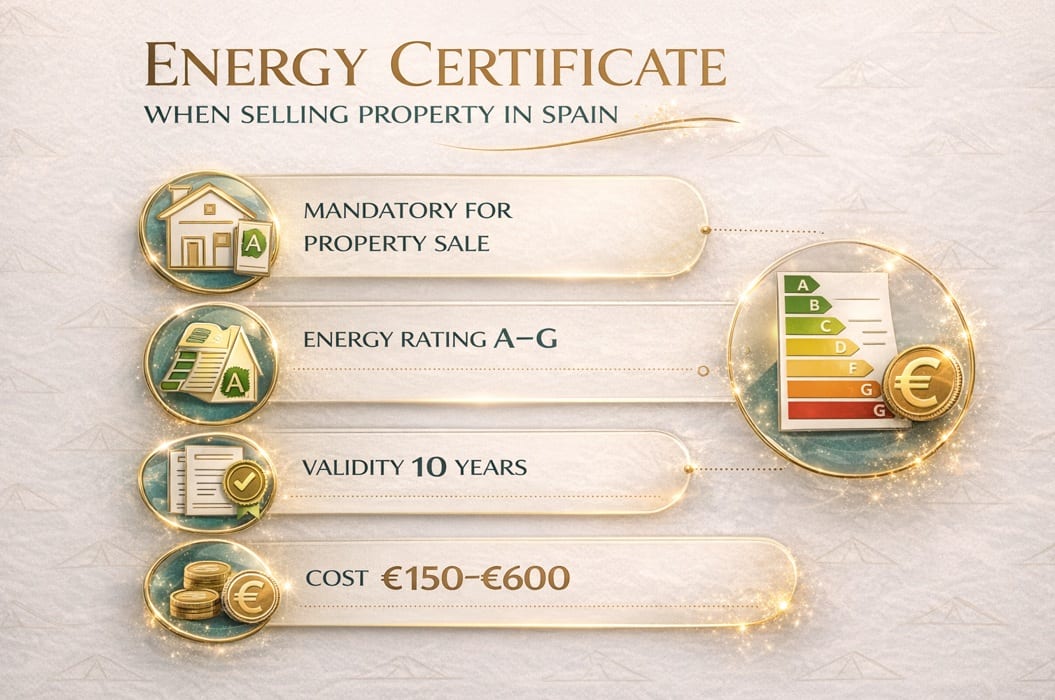
When selling property in Spain, the seller is legally required to provide an Energy Performance Certificate (Certificado de Eficiencia Energética). This document confirms the energy efficiency level of the building or apartment and is mandatory for advertising the property and completing the transaction at the notary.
The requirement was introduced by European Union Directive 2010/31/EU and incorporated into Spanish legislation under Real Decreto 390/2021. Without a valid certificate, the property cannot legally be advertised on real estate portals or sold.
The energy certificate in Spain must be issued by a certified specialist such as an architect, engineer, or qualified technical expert. After inspecting the property, the specialist assigns an energy efficiency rating from A (most efficient) to G (least efficient).
The cost of obtaining the certificate depends on the type and size of the property. In Mallorca, typical prices fall within the following range:
Average Cost of an Energy Certificate
Property Type | Cost |
|---|---|
€150 – €300 | |
€250 – €600 | |
Large properties | €600 – €1,000+ |
The certificate remains valid for 10 years. If the property already has a valid certificate, it does not need to be obtained again.
Failure to provide an energy certificate when selling property in Spain may result in fines ranging from approximately €300 to €6,000, depending on the severity of the violation.
Tax Exemption When Selling Property for Owners Over 65 in Spain
Spanish tax legislation provides an important tax benefit for property owners over the age of 65. Under certain conditions, the profit from the sale of a property may be fully exempt from Capital Gains Tax (IRPF).
The main condition is that the property being sold must be the seller’s primary residence (vivienda habitual). According to Spanish tax rules, a property qualifies as a primary residence if the owner has lived in it for at least three years.
If these conditions are met, the profit from the sale may be completely exempt from capital gains tax, regardless of the amount of profit.
There is also a separate tax benefit for property owners over 65 who sell a property that is not their primary residence. In this case, the exemption may apply if the proceeds are invested in a lifetime annuity (renta vitalicia).
Main Conditions for the Tax Exemption
Condition | Requirement |
|---|---|
Seller age | 65 years or older |
Property type | Primary residence |
Minimum residence period | 3 years |
Tax exemption | Up to 100% of the profit |
Alternative Tax Exemption
Parameter | Value |
|---|---|
Investment in renta vitalicia | Up to €240,000 |
Investment deadline | Within 6 months after the sale |
These tax exemptions when selling property in Spain apply only if the tax declaration is properly filed and supported by the necessary documentation. For this reason, many sellers consult tax lawyers or tax planning specialists before selling property.
Selling Property in Spain with an Existing Mortgage
Selling property in Spain with an active mortgage is possible and relatively common. However, before completing the transaction the mortgage obligation must be fully settled and the mortgage charge must be officially removed from the Land Registry (Registro de la Propiedad).
In practice, the process works as follows: on the day of signing the purchase deed at the notary’s office, part of the buyer’s payment is used to repay the outstanding mortgage balance. The bank then issues a document confirming the closure of the loan (certificado de deuda cero), after which the mortgage entry can be cancelled in the land registry.
It is important to understand that even after the loan has been repaid, the mortgage must still be formally cancelled in the property registry. Without this step, the property may still appear as encumbered.
Sellers should also consider possible early mortgage repayment fees, which depend on the terms of the mortgage agreement.
Main Costs When Selling Property with a Mortgage
Type of Expense | Amount |
|---|---|
Mortgage early repayment fee | 0.25% – 1% of the remaining loan |
Notary fees | approximately €150 – €300 |
Mortgage cancellation registration | €200 – €350 |
Bank administrative fees | €100 – €250 |
Before selling a property, many owners request a certificado de deuda pendiente from their bank to determine the exact outstanding mortgage balance and calculate the amount that will need to be repaid at the time of the transaction.
Read our detailed guide on buying and selling property in Mallorca with mortgage financing: Mortgage in Mallorca 2026: Guide to Buying Property in Mallorca with Financing
Additional Expenses to Consider When Selling Property
In addition to taxes and the main costs associated with selling property in Mallorca, there are also a number of additional expenses that may arise during the preparation and completion of the transaction. Although each property is unique, these costs often appear in practice and may influence the final profit from the sale.
For example, before listing a property, owners often carry out minor cosmetic improvements to enhance the appearance of the property and make it more attractive to buyers. This may include repainting walls, small repairs, updating lighting, or preparing the property for professional photography.
Another important requirement when selling property in Spain is confirming that there are no outstanding debts with the homeowners’ community (Comunidad de Propietarios). The building administration must issue a special document called Certificado de Comunidad, confirming that all community payments have been settled.
Additional costs may also arise for professional cleaning, garden maintenance, or furniture transport if the property is delivered to the buyer without furnishings.
Examples of Additional Costs
Type of Expense | Approximate Cost |
|---|---|
Cosmetic repairs before sale | €500 – €3,000 |
Professional cleaning before photoshoot | €50 – €150 |
Garden maintenance | €100 – €300 |
Certificado de Comunidad | about €20 – €50 |
Furniture transportation | €100 – €500 |
Although these costs may appear small compared to property taxes, proper preparation of a property often helps sell it faster and achieve a higher sale price.
To clearly understand the costs and steps involved in selling property in Mallorca beyond taxes, read our complete guide to selling property in Mallorca.
In it, you will find not only a detailed explanation of the process but also a step-by-step checklist for property sellers in Mallorca.
Sell Property in Mallorca Fast, Safely and Profitably — Complete Guide for Property Owners
Selling Property With or Without an Estate Agent — Pros and Cons
When selling property in Spain, property owners can choose between two main options: working with a professional real estate agency or attempting to sell the property independently. Each of these approaches has its own advantages and limitations.
Selling through a real estate agency in Mallorca usually simplifies the entire transaction process. Professional agencies have access to an international database of buyers, promote properties on major international real estate portals, and organise property viewings for potential clients. In addition, an experienced agency helps coordinate the work of lawyers, notaries, banks, and other specialists involved in the property transaction.
Selling property independently may allow the owner to save on real estate agency commission. However, in this case the owner must personally handle all aspects of the sale, including marketing the property, organising viewings, negotiating with buyers, and collecting all the legal documents required for the transaction.
For many international property owners, navigating Spanish property regulations and taxes without professional assistance can be challenging.
Comparison: Selling With an Agency vs Without an Agency
Criteria | With Agency | Without Agency |
|---|---|---|
Property marketing | Professional marketing and property portals | Self-managed advertising |
Buyer search | International buyer database | Limited reach |
Property viewings | Managed by the agency | Owner manages |
Legal coordination | Coordinated by the agency | Managed independently |
Commission | 4% – 6% + VAT 21% | None |
In practice, many property owners prefer working with professional real estate agencies in Mallorca, as this often leads to a faster sale and helps avoid mistakes related to legal and tax aspects of the transaction.
Professional agencies also have a deeper understanding of the market and know how to properly interpret and analyse it.
To see our expertise in action, take a look at the detailed Mallorca real estate market report we have prepared for you:
Mallorca Real Estate Market 2026: Prices, Forecast & Investment Guide
FAQ — Frequently Asked Questions About Taxes When Selling Property in Spain
1. What taxes do you pay when selling property in Spain?
When selling property in Spain, the seller usually faces several taxes. The main ones are Capital Gains Tax (IRPF) and the municipal Plusvalía tax, which is calculated based on the increase in the value of the land.
If the seller is not a tax resident of Spain, a 3% retention tax (Retención) also applies. In addition to taxes, other costs may arise such as real estate agency commission, bank fees, and the energy certificate required for selling property in Spain.
2. How much is capital gains tax when selling property in Spain?
For Spanish tax residents, a progressive tax scale applies:
Profit | Tax Rate |
|---|---|
up to €6,000 | 19% |
€6,001 – €50,000 | 21% |
€50,001 – €200,000 | 23% |
€200,001 – €300,000 | 27% |
over €300,000 | 28% |
For non-residents selling property in Spain, the tax rate is typically 19% for EU residents.
3. What is Plusvalía tax in Spain?
Plusvalía is a municipal tax based on the increase in the value of the land on which the property is located. It is calculated using the cadastral value of the land and the period during which the property was owned.
The maximum tax rate allowed by Spanish law is up to 30% of the taxable base, although the exact percentage is determined by the municipality.
4. Do you pay tax if you sell property in Spain without profit?
If the seller can prove that the property did not increase in value, capital gains tax may not apply. However, some mandatory charges — such as the Plusvalía municipal tax — may still apply depending on the situation.
5. Who pays estate agent fees in Mallorca?
In Mallorca, the real estate agency commission is typically paid by the seller. The average commission in the market ranges between 4% and 6% of the property sale price, plus 21% VAT (IVA).
6. How long does it take to sell property in Mallorca?
The time required to sell property in Mallorca depends on several factors:
property location
price segment
market conditions
marketing strategy
On average, selling property in Mallorca may take between 3 and 9 months, although well-prepared properties with professional marketing strategies can sell significantly faster.
7. How can you reduce capital gains tax when selling property in Spain?
The taxable base can be reduced by including:
property purchase expenses
notary and registry costs
real estate agency commission
documented capital renovation expenses
In some cases, tax exemptions may also apply, for example when reinvesting in a primary residence or when the seller is over 65 years old.
Conclusion
Selling property in Mallorca involves much more than simply finding a buyer. Property owners must also understand the tax obligations and associated costs of selling property in Spain. Capital Gains Tax, municipal Plusvalía tax, the 3% retention for non-residents, bank fees, and administrative costs can all influence the final profit from the sale.
Proper preparation of the transaction helps avoid unexpected expenses and allows sellers to accurately estimate their final financial result. For this reason, many property owners prefer working with professional real estate agencies and tax advisors who can organise the entire sale process efficiently.
Why Work With Aventin Real Estate
Selling property in Mallorca is a complex process that requires not only market knowledge but also effective coordination between lawyers, notaries, banks, and tax specialists. Aventin Real Estate helps property owners navigate this process smoothly and efficiently.
Our agency specialises in selling property in Mallorca and works with international buyers from across Europe, the United Kingdom, and other global markets. As a result, our clients’ properties receive exposure to a broad international audience and a professional marketing strategy.
Why Property Owners Choose Aventin Real Estate
- deep knowledge of the Mallorca real estate market
- international buyer network
- professional property marketing strategies
- assistance in preparing the property for sale
- coordination of the transaction with lawyers and notaries
- full support for sellers throughout the entire process
While we do not perform tax calculations ourselves, we can recommend trusted tax lawyers and legal specialists who help sellers properly prepare documentation and structure the transaction.
If you are considering selling property in Mallorca, our team will be happy to help you evaluate your property, develop a selling strategy, and find the right buyer.
Contact Aventin Real Estate to receive a professional consultation and discover the real market value of your property.
Related Articles:
1. Mallorca Real Estate Market 2026: Prices, Forecast & Investment Guide
2. Mortgage in Mallorca 2026: Guide to Buying Property in Mallorca with Financing
3. Sell Property in Mallorca Fast, Safely and Profitably — Complete Guide for Property Owners
4. Possible Break in US–Spain Economic Relations: What It Means for the Mallorca Real Estate Market
5. The “New York Effect”: Why Mallorca Is the New Luxury Hub for Global Investors
Property for Sale in Mallorca – Explore by Type and Location
To explore more property opportunities in Mallorca, browse our main categories below.
Whether you are looking to buy property in Mallorca, find villas for sale, explore apartments in Mallorca or discover new developments and investment properties, you will find carefully selected listings across the island’s most desirable areas such as Palma, Santa Ponsa, Cala Vinyes and Southwest Mallorca.
Start exploring Mallorca properties and find your perfect home today.
General Listings | Property Types | The Most Popular Locations | ||
|---|---|---|---|---|
Author: Aventin Real Estate Experts